
How Much Does a Foreign Trade Website Cost: The 6 Line Items Behind the Difference Between 8,000 and 30,000 Quotes
For foreign trade websites, quotes range from a few thousand to tens of thousands, and the difference isn't about whether it's expensive but about what you're actually buying. How much a foreign trade website costs mainly depends on four areas: domain and server, theme or custom development, multilingual and Google SEO foundation, and product images plus ongoing maintenance. This article gives you a cost breakdown table and a comparison of three price tiers. Use it to check item by item which th
目录
- The 6 line items on a quote that create the gap between 8,000 and 30,000
- Three price tiers and which type of factory each suits
- The 6 items most easily missing from quotes — ask about each before signing
- How to judge whether a quote is reliable: 4 verifiable actions
- Don't skimp on product images — they directly affect inquiries
I came across a set of food product hero images that recently went viral, and I want to talk about the thinking behind them: in food export, some people get a website quote of 8,000, others get 30,000, and both proposals say "includes multilingual, includes Google SEO." How much is a reasonable price for a foreign trade website, and what exactly are you buying with that extra 20,000+?
Let me give the conclusion first: the difference between 8,000 and 30,000 is 90% not about "whether the technology is good," but about which specific deliverables you're getting. Break the quote into line items and it becomes obvious at a glance.
The 6 line items on a quote that create the gap between 8,000 and 30,000
The table below shows common cost components and approximate ranges in the market. You can use it directly to compare against the quote you have in hand. The ranges are wide because categories and languages differ; the exact quote needs to be evaluated based on your requirements.
| Cost item | Common approach at the 8,000 level | Common approach at the 30,000 level | Common market range |
|---|---|---|---|
| Domain | Ordinary .com, registered under the service provider's name | Brand-related domain, registered under your own account | 60–150 yuan/year |
| Server and hosting | Shared hosting, no CDN | Dedicated cloud server + CDN, overseas nodes | 300–3,000 yuan/year |
| Design | Ready-made theme, change colors and banner | Custom homepage and product pages based on brand | Ready-made 0–3,000 yuan; custom 5,000–30,000 yuan |
| Multilingual | Plugin machine translation, usually English only | Human translation, 2–4 languages | 800–3,000 yuan per language |
| Product images and copy | Phone photos, write your own English | White-background images + lifestyle images + English copy | Shooting and retouching 30–150 yuan/image |
| Post-launch maintenance | Not included; each change billed separately | Includes backups, security, minor changes | 1,000–5,000 yuan/year |
An 8,000 site is mostly template application + shared hosting + self-taken photos. It can go live, but content pages and SEO structure are basically not done. In a 30,000 site, the extra money usually goes mainly into three areas: custom design, human translation, and product photography. For the complete logic of cost composition, the Website Costs and Quotes section breaks it down in more detail.
Three price tiers and which type of factory each suits
| Approach | Time to launch | First-year cost range | Ongoing annual fee | Best for |
|---|---|---|---|---|
| SaaS template site | 3–7 days | 3,000–8,000 yuan | 2,000–6,000 yuan | Few SKUs, testing the waters first, no technical staff |
| WordPress semi-custom | 15–30 days | 8,000–25,000 yuan | 1,000–3,000 yuan | Long-term Google SEO, need to write content pages |
| Custom development | 45–90 days | From 30,000 yuan; higher for complex features | Calculated separately based on maintenance scope | Need ERP integration, have a distributor system, or online product selection |
Which tier to choose is not about budget level, but about how the business runs. If your main battlefield is still marketplaces and you just want a website to catch customers first, SaaS is enough. If you want long-term free inquiries from Google and need to keep writing industry content, WordPress semi-custom is more cost-effective. Only if you have a distributor system, need ERP integration, or do online selection/configuration do you need custom development.
For a more detailed comparison of the three paths, see Independent Site Platform Comparison; I won't repeat it here.
The 6 items most easily missing from quotes — ask about each before signing
- Whose name is the domain under. If it's registered under the service provider's name, you may not get it back if you later want to switch providers.
- Where is the server, and is there a CDN. If customers are in Europe or America and the host is in China, it can take over 5 seconds to open on mobile.
- SSL certificate and business domain email. Low-price quotes usually install only a free certificate; domain email is purchased separately.
- Is multilingual machine translation or human translation. Customers can spot machine-translated German or Spanish pages at a glance, and inquiry quality differs a lot.
- How changes after launch are billed. Per-change fees are commonly 200–500 yuan/time; an annual package saves money but check what's included.
- Can you take the source code and data with you. Especially for SaaS sites; be sure to ask clearly about export functionality in advance.
How to judge whether a quote is reliable: 4 verifiable actions
- Ask for a list, not a total price. If the words "website included" can't be broken down into more than 5 line items, it's basically template output.
- Ask them to show a live site, open it on mobile over 4G, and if it hasn't appeared by the count of 3 seconds, ask where the server is hosted.
- Ask who manages it after launch. Who answers emails, how long it takes, whether changing a banner costs money — put these in the contract before signing.
- Look at payment milestones. Common structures are 3-4-3 (30% on signing, 40% before launch, 30% on acceptance) or 5-5; be extra cautious if they require full payment upfront.
If you want to see what real site owners' sites look like and where the money goes, browse Foreign Trade Independent Site Cases; comparing directly is more useful than listening to a pitch.
Don't skimp on product images — they directly affect inquiries
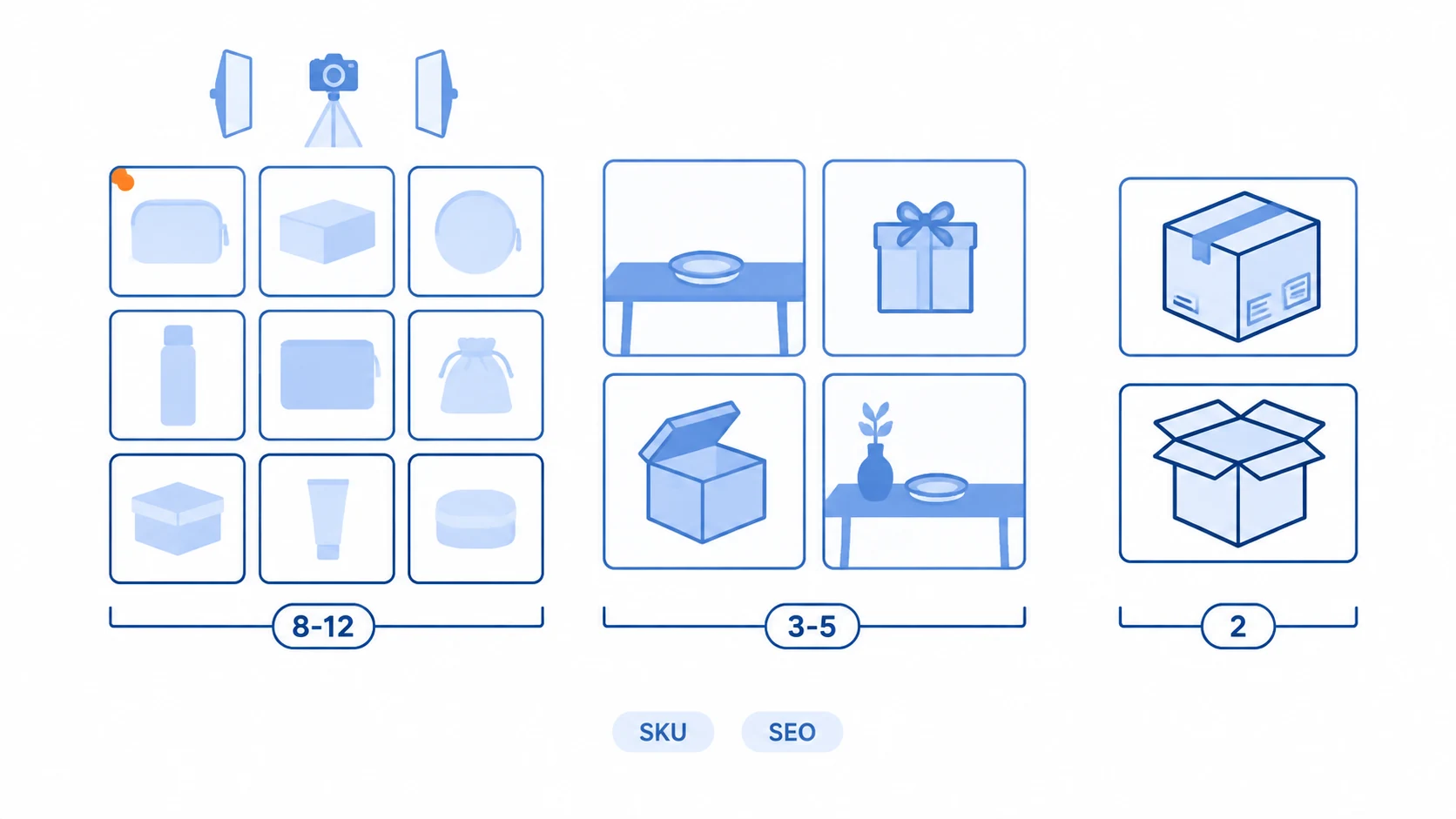
For food-related foreign trade sites, product images basically determine whether customers stop scrolling. High-key light boxes, shadowless white backgrounds, 45-degree overhead angles — the texture and juice of dried fruit need to be clearly visible. This isn't an aesthetic issue; it's a conversion issue.
A usable set of images looks roughly like this: 8–12 white-background hero images (for each main SKU, at least one straight-on shot plus one 45-degree shot), 3–5 lifestyle images (dining table, gift box, opened bag), and 2 packaging images. Shooting plus retouching commonly runs 30–150 yuan/image in the market; including models or complex styling will be higher.
Before uploading images to the site, there are three small things to do: change file names to English keywords, write clearly in alt what product it is, compress to WebP and keep it under 200KB. Do these three steps, and the images themselves can also bring traffic from Google Image Search.
Write down this image production approach and apply it directly next time you launch a new product.
For how to spend money on the website, you can first do a free website requirement assessment: explain your products, target countries, and main categories clearly, and we'll give you a cost list based on the items above. Then you can decide whether it's 8,000 or 30,000.