
Should You Use Cross-Border B2B Trading Platforms: 3 Standards to Calculate Yourself First
You are hesitating whether to continue investing in cross-border B2B trading platforms or to build a controllable independent website. Having built independent sites for 8 years, I've seen factories pay annual platform fees while failing to extract their own customer data. The core evaluation is straightforward: platforms are short-term trading arenas, whereas independent sites are assets that accumulate domain names, data, and keywords. This article provides 3 DIY standards evaluating customer
目录
- First, Separate Cross-Border B2B Trading Platforms from Independent Foreign Trade Websites
- Evaluation Standard 1: Can Customer Information Eventually Enter Your Own Database?
- Evaluation Standard 2: Direct Translation of Product Keywords Might Mean Nobody Is Searching for Them
- Evaluation Standard 3: Platform Annual Fees Are Rent; Independent Site Investments Are Assets
- Top 3 Pitfalls of Cross-Border B2B Trading Platforms
First, test yourself with three questions: When your current overseas customers search for you, do they search by product keywords or browse inside a B2B platform marketplace? Can you export complete customer contact details, quotation logs, and transaction data at any time? If the platform changes its commission rate or ranking algorithm next year, do you have a customer acquisition channel that bypasses the platform?
If any of these answers make you hesitate, it is worth weighing cross-border B2B trading platforms and independent foreign trade websites separately. Having been in this industry for 8 years, we have taken on many accounts that kept paying platform fees while failing to extract their own customer data. Platforms are not bad, but they are a completely different thing from the "foreign trade official website" you expect. I broke down domain names and data ownership in An Independent Site Is Not a Platform; here, I will only focus on how to evaluate them.
First, Separate Cross-Border B2B Trading Platforms from Independent Foreign Trade Websites
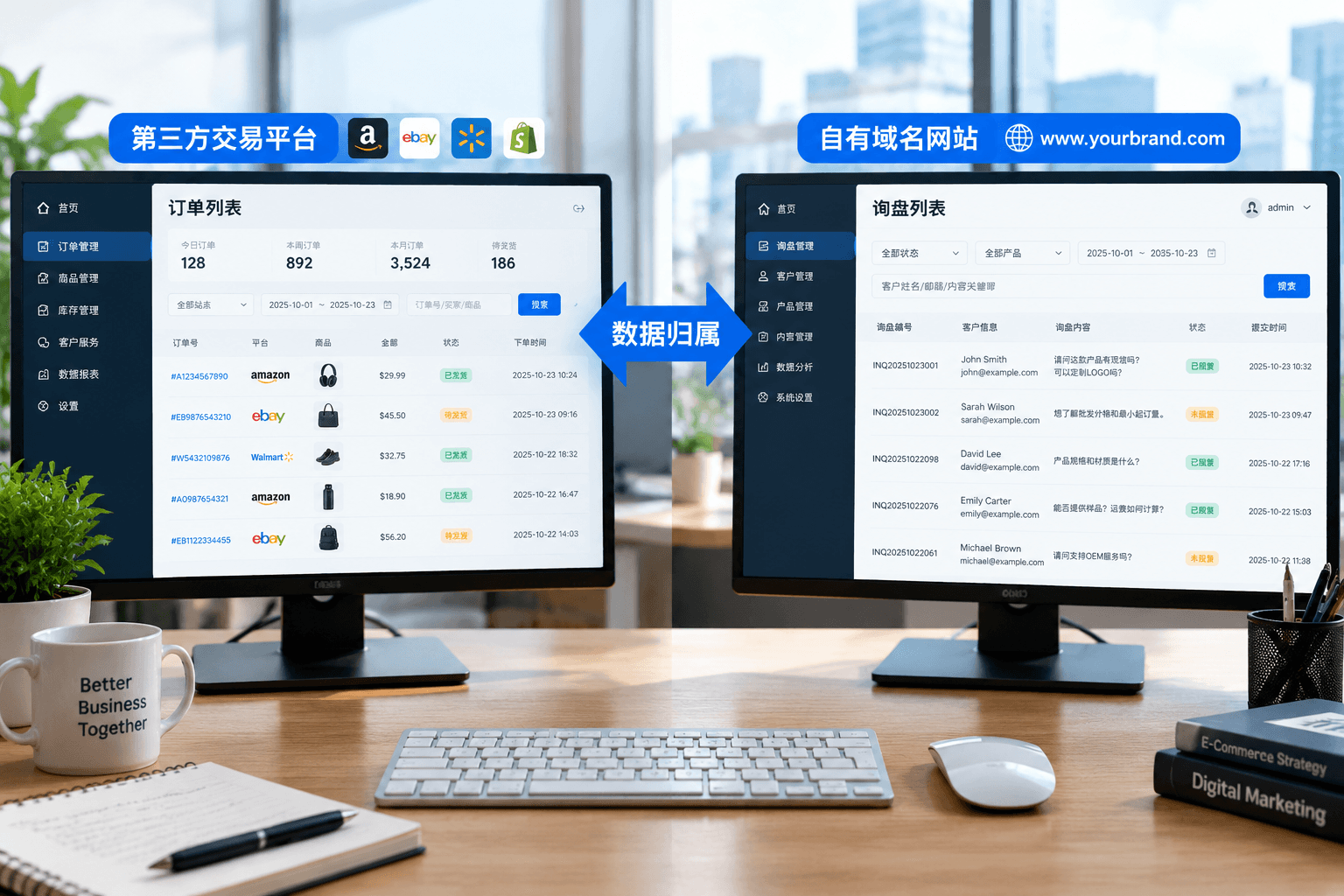
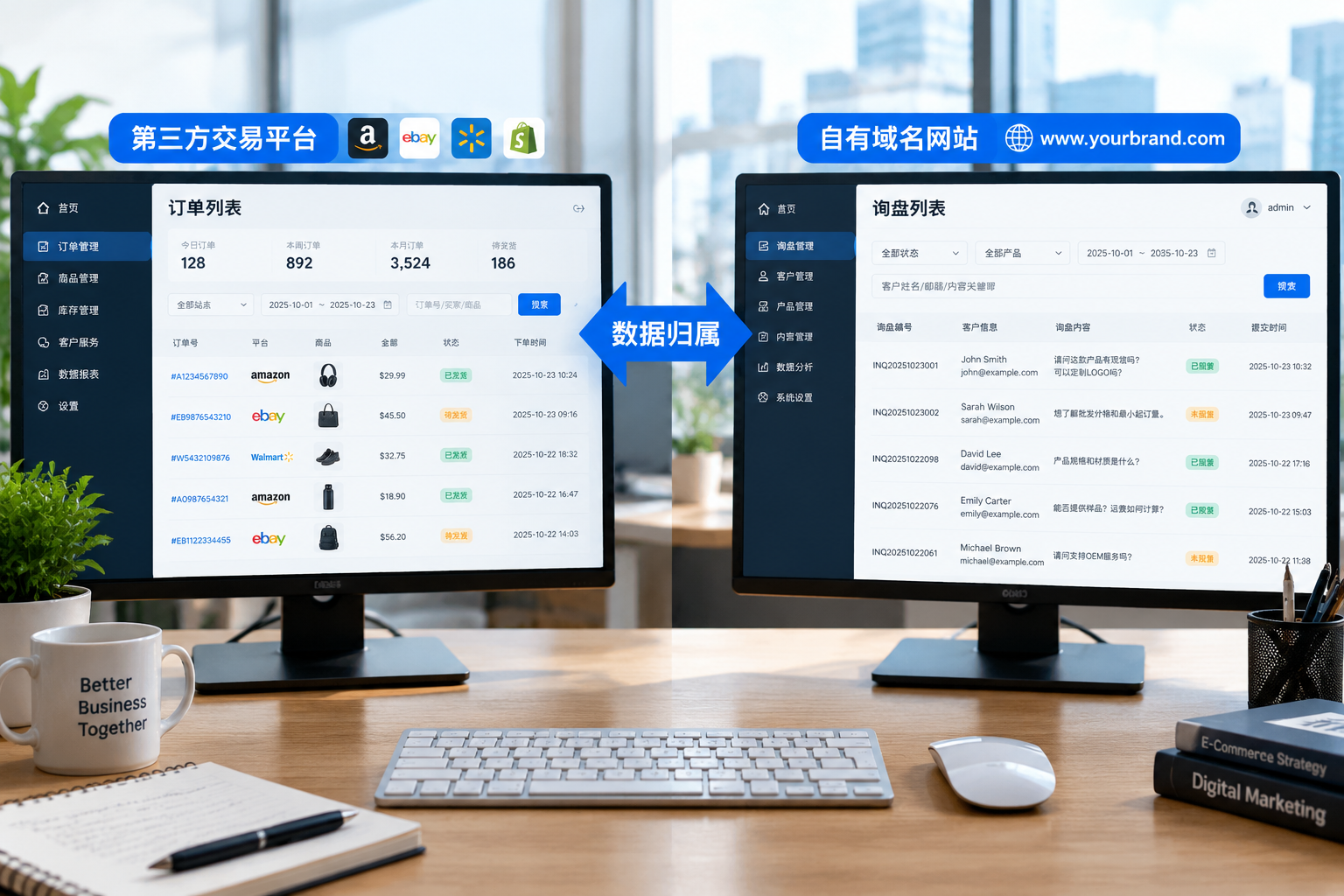
In our industry, we are accustomed to viewing cross-border B2B trading platforms as third-party marketplaces like Alibaba International Station or Made-in-China. They provide you with ready-made buyer traffic, payment processing, and trust endorsement, but the domain name, transaction data, and ranking algorithms all belong to the platform.
An independent foreign trade website is completely different: you own the domain name, customer inquiry information goes directly into your own backend, and the rules are governed only by search engines and payment gateways. The financials of the two are not the same.
- A shop on a platform is more like renting a stall in a wholesale market, with rent and advertising fees changing every year.
- An independent website is like buying or taking a long-term lease on a storefront on the street; the decoration and sign belong entirely to you.
Do not put your platform shop on your business card as your official website. Buyers remember the platform's link, not you.
Evaluation Standard 1: Can Customer Information Eventually Enter Your Own Database?
Phenomenon: We have seen some foreign trade companies use online trading platforms for years, yet customer profiles can only be viewed in the platform's backend, and exports remain restricted.
Reason: Platforms need to maintain a closed-loop transaction, so customer relationship data will never be fully handed over to you.
How to avoid it: First, list the three things you cannot afford to lose—customer emails, historical quotations, and repeat purchase records. Then check if the platform allows you to fully export them. If not, it means you need at least one independent website channel to make up for the gap.
When we work on projects, some factories use the platform as a traffic funnel, then direct customers to fill out forms on their independent website to leave complete information. This is not bypassing the platform, but rather securing inquiry assets in your own hands.
Evaluation Standard 2: Direct Translation of Product Keywords Might Mean Nobody Is Searching for Them
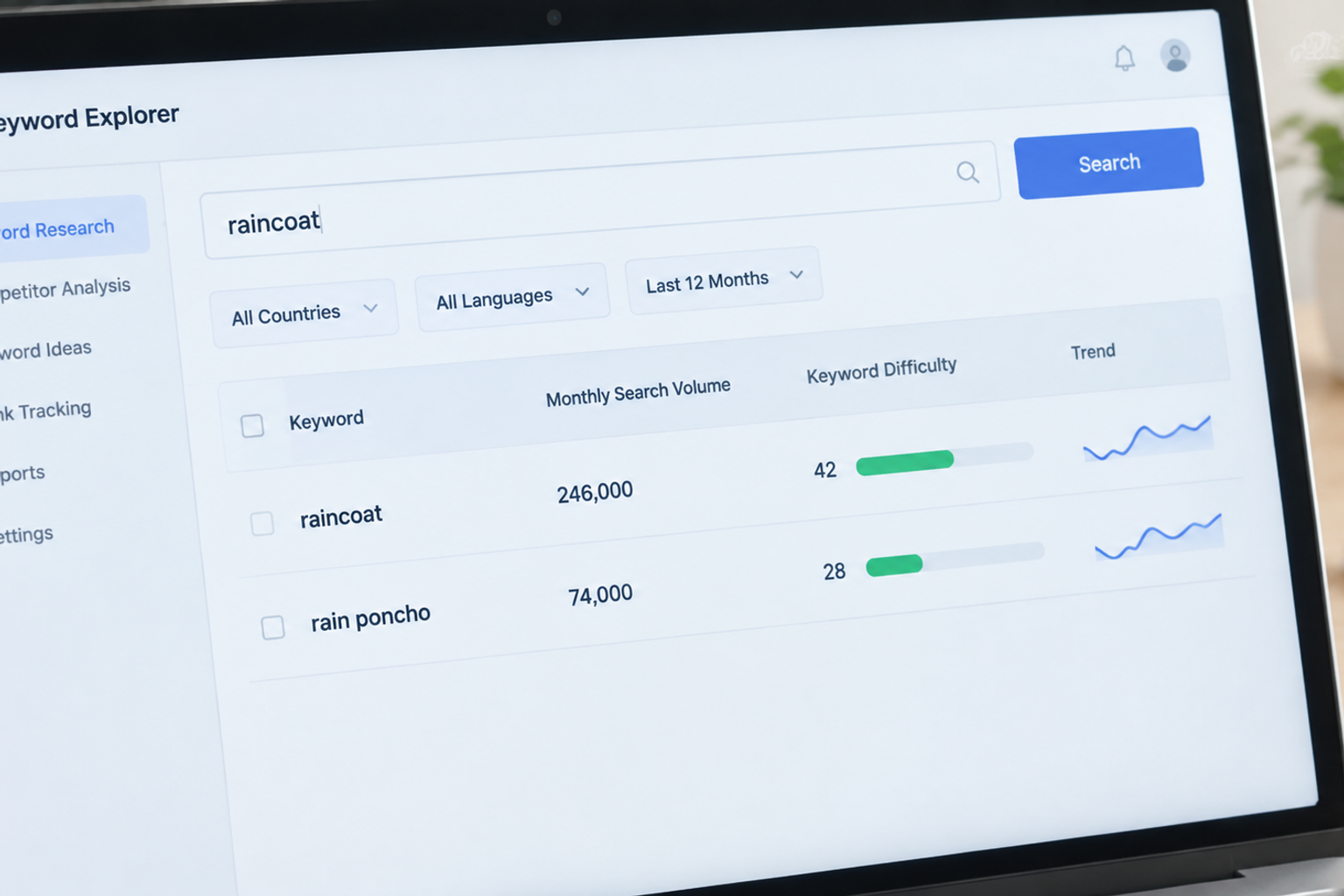
Next, let's talk about keywords. I once had a client making raincoats who translated "raincoat" directly according to the Chinese term to build rankings, only to find the search volume was very small. Later, when we pulled keywords using Ahrefs and Semrush, we found that overseas buyers heavily search for rain poncho, along with root terms like waterproof poncho and emergency rain poncho.
Behind this is a point we repeatedly emphasize during keyword research: direct Chinese-to-English translations of product terms often have pitfalls, so you need to look at them from multiple regions and angles.
You can use Ahrefs or Semrush to check three things: search volume, keyword difficulty, and related queries. In our industry, we call this tool-driven process keyword mapping. Simply put, don't try to force a single term globally.
- First, break down English synonyms based on product material, purpose, and usage scenarios.
- Then, look at the search volume differences between the US, UK, and Australia; don't just look at the total volume.
- Finally, single out words that can convert, and distribute them between your independent site pages and platform product titles.
Here I also recommend combining the systematic approach of keyword research rather than relying solely on a Chinese-language gut feeling.
Evaluation Standard 3: Platform Annual Fees Are Rent; Independent Site Investments Are Assets
Phenomenon: Platform annual fees, ad spend, and transaction commissions are paid year after year, yet when balancing the books at year-end, customer profiles and rankings still follow the platform.
Reason: You are buying current platform traffic, not cumulative ranking and content assets.
How to avoid it: Split your annual budget into two parts. Keep investing one part in the platform to buy instant traffic, and invest the other part in independent site pages, content, and basic SEO. An independent site won't replace the platform overnight, but after a year, you will see which keywords start gaining impressions and which inquiries come in independently of the platform.
In a foreign trade B2B project I handled, the client kept both a platform shop and an independent site simultaneously. The platform handled fast conversions, while the independent site drove long-term inquiries and brand endorsement. This structure is much steadier than choosing just one.
Top 3 Pitfalls of Cross-Border B2B Trading Platforms
- Pitfall 1: Only investing in platforms without buying a domain name. Once the platform ranking changes, traffic drops instantly. Prevention: Register a brand domain name first so your business card and social media at least have a landing home.
- Pitfall 2: Directly translating product terms based on Chinese names. Overseas buyers search for completely different terms. Prevention: Run a multi-region keyword list using Semrush or Ahrefs.
- Pitfall 3: Treating a platform shop as the company's official website. When partners check your background, they cannot see your independent site or complete credentials. Prevention: Ensure your independent site homepage clearly displays company info, a product catalog, and inquiry entry points.
The common thread among these three pitfalls is treating rented entry points as your own foundation.
Of course, this evaluation framework does not apply to every situation. If you have already decided to rely solely on platforms and touch no independent websites, or if your current clients are entirely driven by referrals without depending on online new customers, you don't need to force this model.
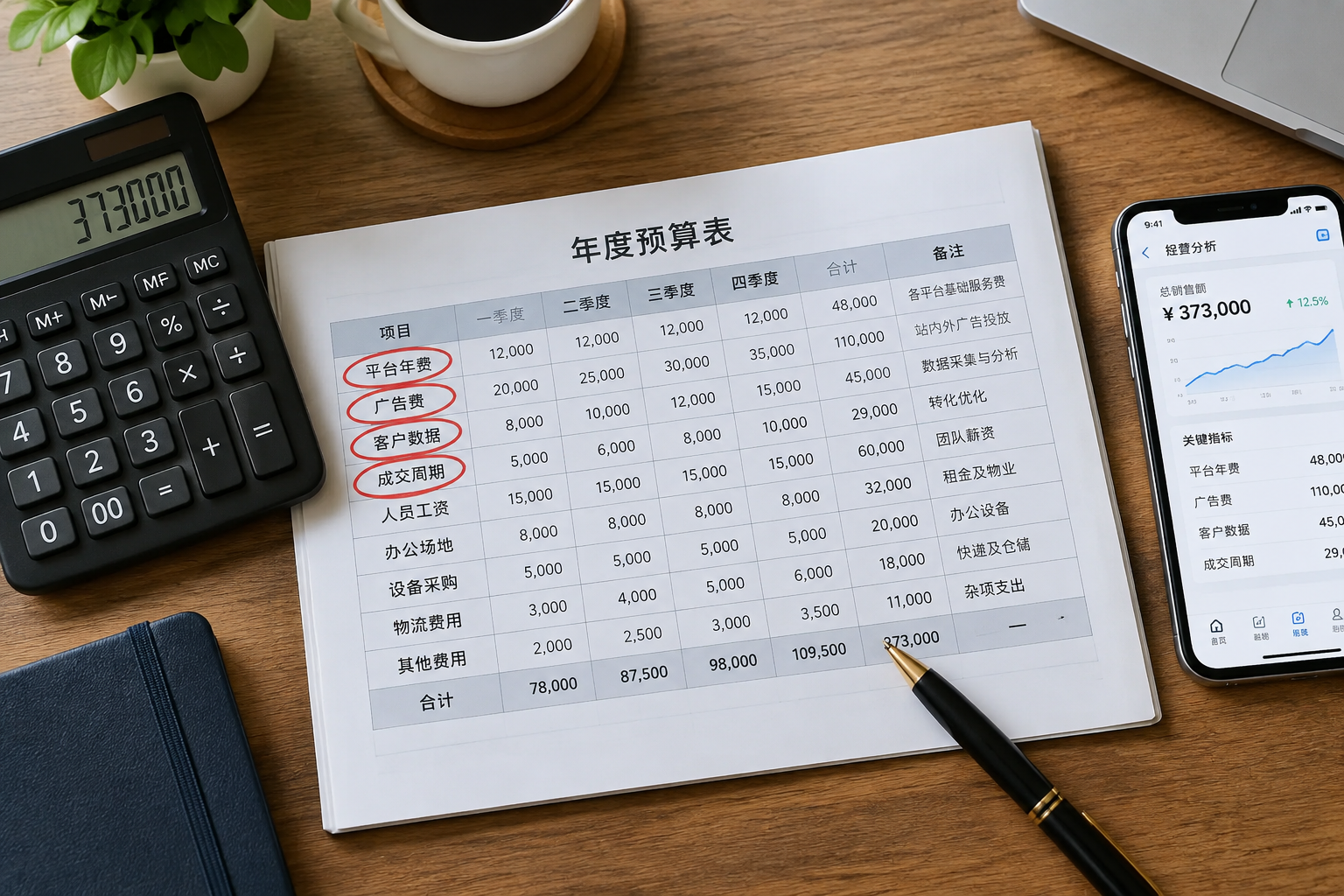
Conversely, if you want to start turning customers and keywords into your own assets, you can create a spreadsheet first: list the platform annual fee, advertising costs, exportable customer data, and sales cycle. If calculations show a persistent gap on the data side, you can decide whether to build an independent site channel to supplement it.
If you need us to integrate both paths into a single budget sheet, feel free to leave your requirements at Independent Foreign Trade Website Construction Services. We will provide a detailed quotation within 1 working day—not guaranteeing a platform replacement, but helping you clearly lay out the numbers and boundaries.