
What types of cross-border e-commerce stores are there: 3 platform types and independent sites, matched with 5 criteria
Don't rush to count platforms just yet. Let me first help you break down what cross-border e-commerce stores actually are—platform stores are like renting a stall, while independent stores are like building your own property. Having run foreign trade independent sites for 8 years, I've seen too many people treat opening an Amazon shop as the entirety of cross-border e-commerce, only to find all customer data in someone else's hands. This article lists common platform and independent store types,
目录
- First, divide "stores" into two categories, don't mix them up when choosing
- What platform stores exist, and who are they for?
- What independent stores exist, and who are they for?
- Fit yourself in: 5 criteria to help you decide which to do first
- The indexing issue that independent stores cannot bypass
- Conclusion: Choose the right store type first, then talk about the next steps
First, let's ask three questions: Is the product in your hands a standardized fast-moving consumer good, or a custom component that requires back-and-forth communication? Do your customers mainly reach you through platform traffic, or do they find you via Google search? Do you have a technical person who can modify code and manage servers? Once you answer these three questions, looking at the types of cross-border e-commerce stores will no longer leave you confused by platform lists.
Over the years of building independent foreign trade websites, almost every month someone comes to ask: Boss, what kinds of cross-border e-commerce stores are there anyway? I usually first have them break down the word "store," otherwise it's very easy to conflate opening an Amazon shop with building an independent website.
First, divide "stores" into two categories, don't mix them up when choosing
We are used to dividing cross-border e-commerce stores into two layers: platform stores and independent stores.
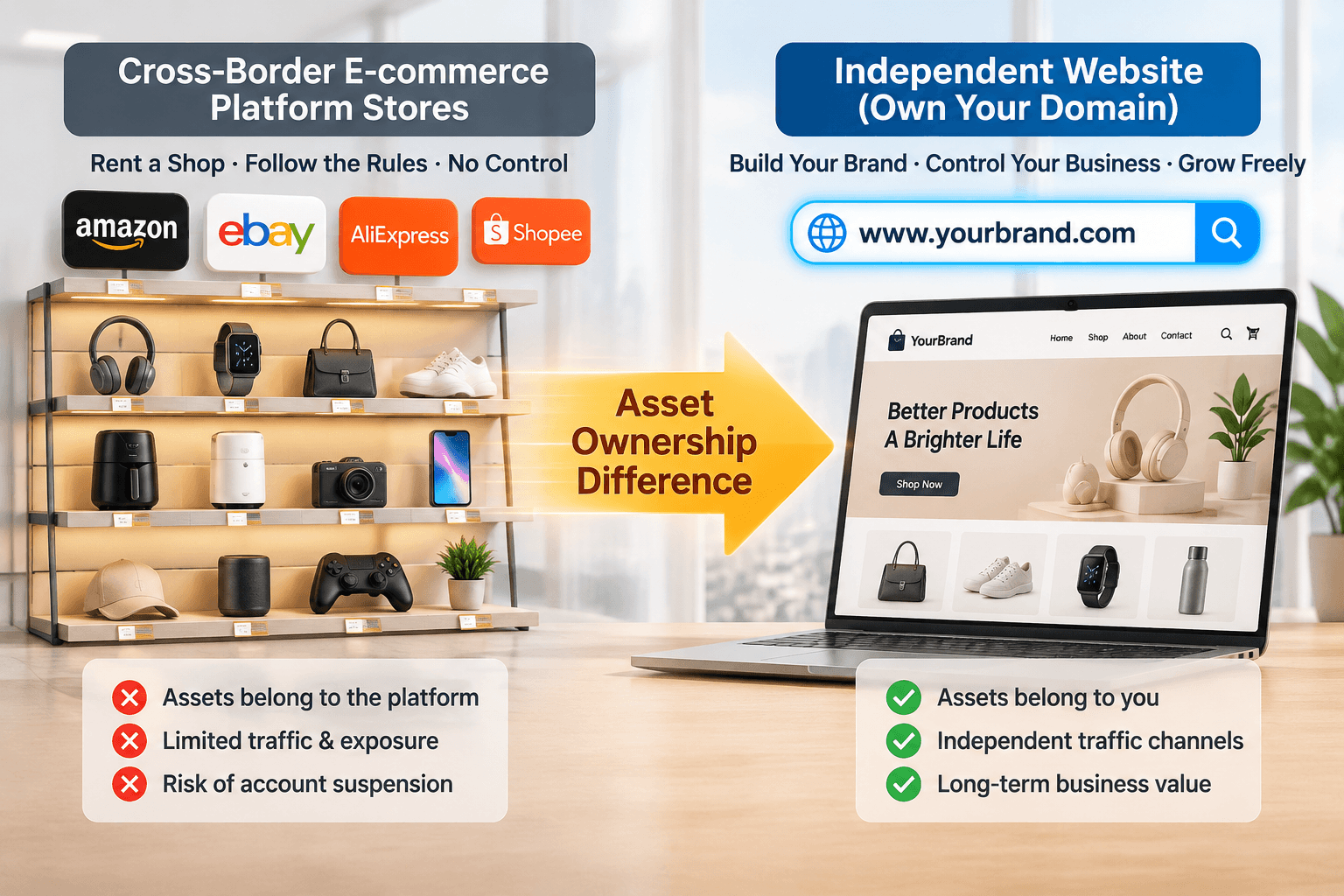
Platform stores mean renting a stall on platforms like Amazon, AliExpress, eBay, or Shopee, where traffic and settlement rules are entirely dictated by the platform. An independent store is a website where you register your own domain name, build the site yourself, and use Shopify, WordPress, or custom development, keeping customer data and content structures firmly in your own hands.
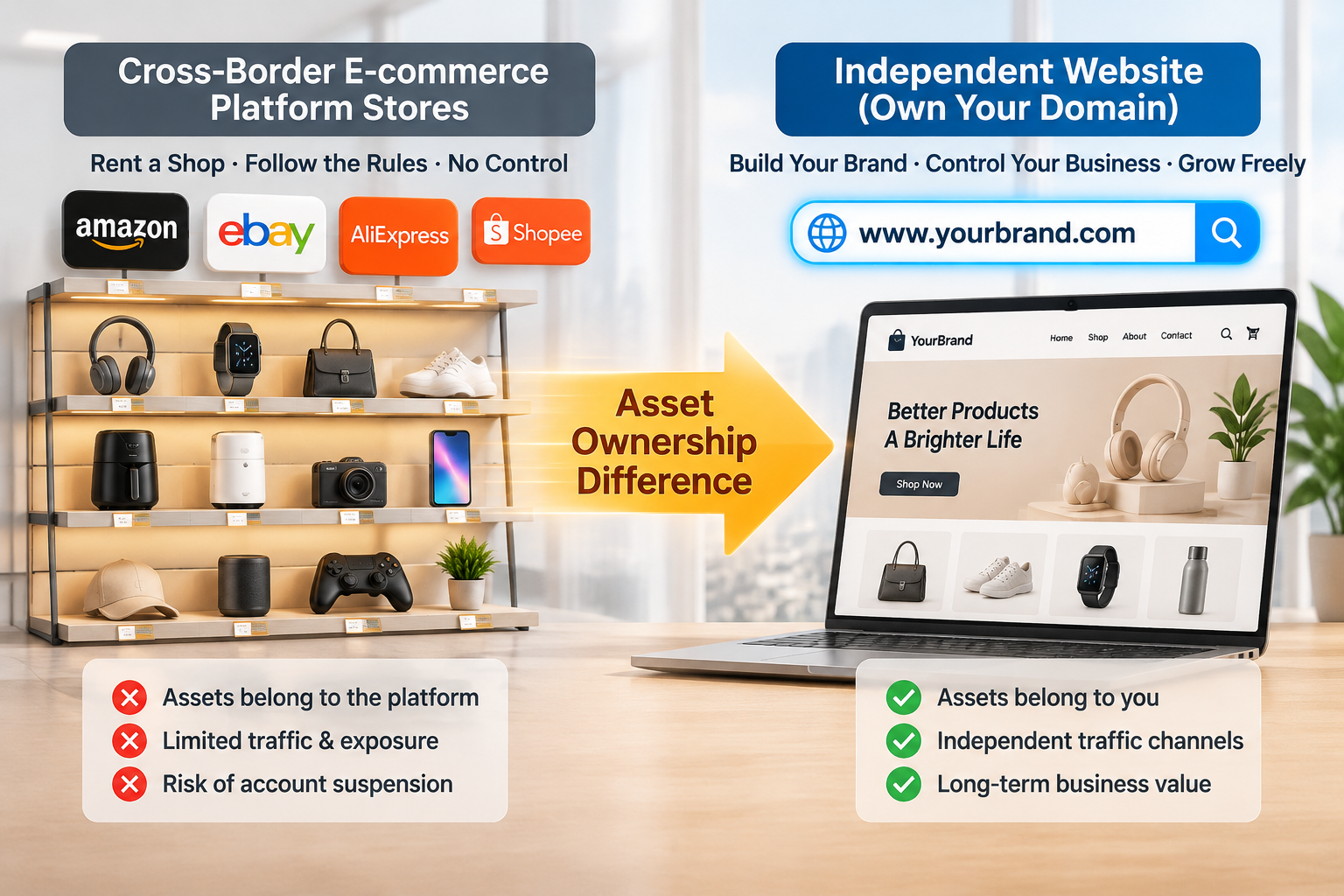
Saying that cross-border e-commerce stores are just Amazon shops is far too narrow a perspective.
Platform stores are just one path; independent stores are the path that keeps customer emails, inquiry records, and purchasing behaviors right in your own database.
Both paths can generate orders, but one rents traffic while the other builds assets.
What platform stores exist, and who are they for?
Common platform stores are not complicated and generally fall into a few categories:
- General e-commerce platforms: Amazon, eBay, AliExpress, Shopee. Suitable for standardized products, fast-moving consumer goods, and product testing.
- Regional platforms: Such as Lazada in Southeast Asia, Mercado Libre in Latin America, and Ozon in Russia. Suitable for sellers with clearly defined target markets.
- B2B platform stores: Such as Alibaba.com, suitable for factories and trading companies to generate inquiries, though platform rules and ranking logic change frequently.
The advantage of platform stores is that they are quick to get started with, especially when you lack a technical team—registration, listing, and payment solutions are all ready-made. The cost is also very direct: commissions, advertising fees, and promotional slot fees rise year by year, customer data is incomplete, and any rule change can cause rankings to fluctuate wildly.
What independent stores exist, and who are they for?
Based on how they are built, I usually divide independent stores into three types:
- SaaS website builders: Such as Shopify, monthly subscription, template-based, suitable for direct-to-consumer (DTC) retail testing.
- Open-source website builders: WordPress with WooCommerce, high flexibility, suitable for teams wanting to deeply engage in content marketing and B2B inquiries.
- Custom development: Tailored for complex functions, such as multilingual site groups, cross-border payments, and logistics system integration. Higher upfront investment, but lower long-term modification costs.
When building foreign trade B2B official websites, we lean more towards WordPress or custom solutions because inquiry scenarios require product details, company introductions, and technical documents to link together. If you are still torn between the inquiry efficiency of B2B platforms and independent websites, you can check our previous breakdown What is the difference between foreign trade B2B website building services and cross-border e-commerce independent websites?, which explains the conversion logic of both paths in detail.
Independent stores won't immediately bring organic traffic in the early stages, but once Google indexing and rankings pick up, customers will actively seek you out, and the customer data belongs to you.
Fit yourself in: 5 criteria to help you decide which to do first
I am giving you a checklist you can directly cross-reference, where you can only choose one answer per criterion.
- Product type: If the product is standardized and price wars are fierce, start with platform stores for product testing; if it's customized, has many parameters, and requires technical communication, an independent store is more suitable.
- Capital model: Platform stores are a business of continuously burning money on ads; independent stores require upfront investment in site building and SEO, leading to more stable customer acquisition costs later.
- Customer assets: Platform customer data belongs to the platform, and you can only see orders; independent stores capture emails, inquiry content, and browsing behavior, which form the basis of repeat purchases and content marketing.
- Technical capability: Lacking a technical team, you can start with SaaS platforms or platform stores; with a budget to hire website building services, independent stores can also launch quickly.
- Long-term goals: If you just want quick money, platform stores pay off fast; if you want to build a brand, drive repeat purchases, and do foreign trade B2B, an independent store is an indispensable step.
You don't need to understand all five; just check them off one by one, and you'll have your answer.
The indexing issue that independent stores cannot bypass
Many business owners think that once an independent website is built and launched, everything is done. In fact, there is a more hidden trap here: If Google doesn't index it, even the best-looking site equals having no store at all.
The most common scenario when launching a new site is that a month after going live, checking via site:yourdomain reveals that only the homepage is indexed, and all inner pages are completely out of the index. The reasons are simple:
- No sitemap submitted: Google doesn't know how many URLs you have and can only stumble upon them through external links.
- Thin content: Category and product pages are heavily duplicated or consist only of images with no indexable text information.
- Missing internal links: Pages do not link to each other, and Google's crawler stops after scraping the homepage.
- Robots file blocking: Some technical teams mistakenly carry development environment rules live, locking Google spiders outside the door.
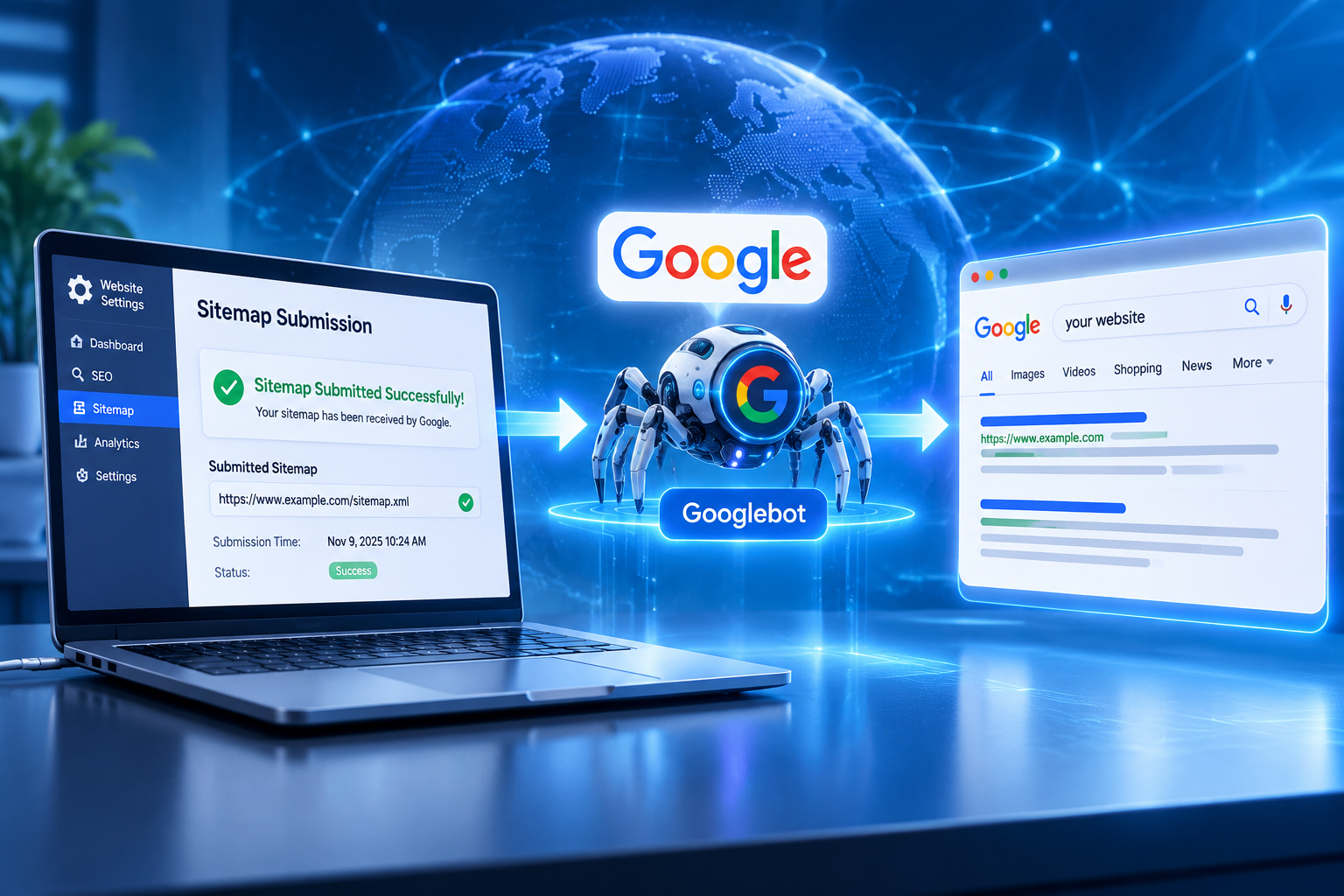
The solution isn't complicated either: generate and submit a sitemap on launch day, enable IndexNow for active pushing, add at least 3 internal links to every important page, and ensure product descriptions are not copy-pasted. We don't promise how soon indexing will happen because Google's indexing cycle is affected by site authority, content quality, and crawling budget, but laying a solid foundation will make the indexing speed significantly faster.
Conclusion: Choose the right store type first, then talk about the next steps
Finally, here is a saveable checklist of key points. Next time you talk to someone about "what kinds of cross-border e-commerce stores exist," just follow these talking points:
- Two types of stores: Platform stores rent traffic, while independent stores build assets.
- Platform representatives: Amazon, AliExpress, eBay, Shopee, Alibaba.com. Suitable for product testing and standardized fast-moving goods.
- Decision criteria: Product type, capital model, customer assets, technical capability, long-term goals—5 criteria to find your fit.
- Must-dos after launching an independent store: Submit sitemap, enable IndexNow, build internal links, and write sufficient content. This is the prerequisite to being seen by Google.
Figure out first whether you want to rent a stall or build your own building. Once you've figured that out, decide how to build it.